
Build your own AI creator
The full recipe, from an empty brief to a character that posts every day: the models, the prompts, the filming rules, what it costs per month, and where the manual work piles up.
Five rules
The AI characters that took off on TikTok this autumn share one pattern. Nobody talks. A strange-looking person does something ordinary, in a real place, with a trending sound under it. Everything below follows from these five rules.
- One frame
Odd hair, one signature outfit, one trait people argue about. Bold or extreme, never average.
- Real motion
A real person does the move. A model swaps the character in, so the movement stays human.
- No words
No dialogue, no text on screen. A trending sound, picked in the TikTok app.
- Volume
Most clips stay small and a few carry the account. Plan several a day.
- Openly AI
The bio says it, every caption says it, the platform's AI label is on.
The stack
| Service | What for |
|---|---|
| FAL | Every image and video model below: Seedream v4 for stills and sheets, MiniMax H3 recast for the swap, Kling v3 for new scenes |
| An LLM | Character concepts, the bio, post text |
| Storage with public URLs | The models fetch inputs by URL, and their output links expire. Copy every result into your own bucket at once |
| One email per character | Sign-ups and verification codes |
| A phone | Phone checks, posting, picking the sound |
| Typefully (optional) | Scheduling to X. It does not post to TikTok or Instagram |
Cast the character
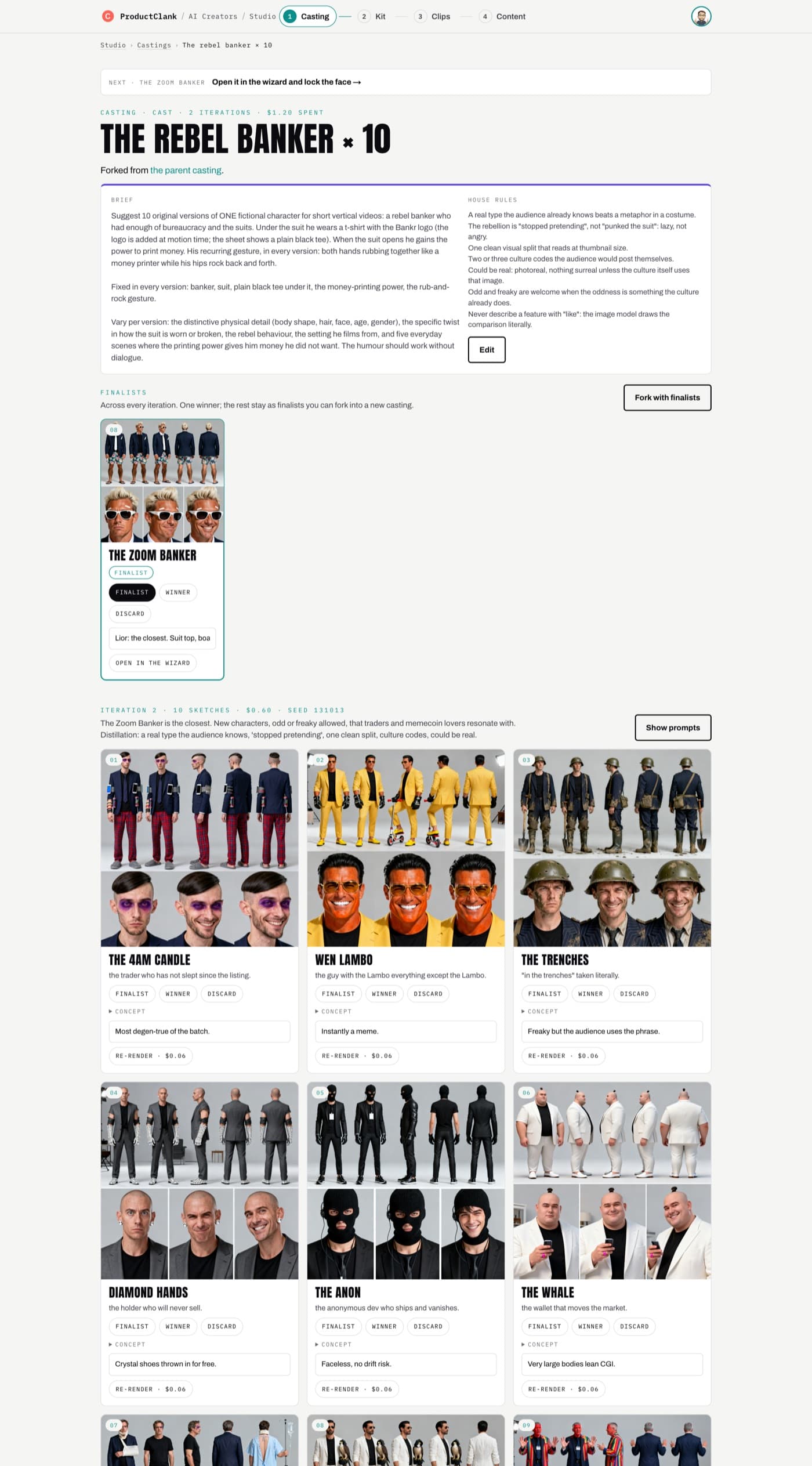
Do not design one character. Generate ten, look at them side by side, keep the best two or three, and run again with one line of feedback. The loop is the work.
Write a short brief: what stays the same in every version. Then give the concept writer house rules. These held up across our castings:
- A real type the audience already knows beats a metaphor in a costume.
- One clean visual split that reads at thumbnail size.
- Two or three culture codes the audience would post themselves.
- Could be real. Odd is fine when the culture already does that oddness.
- Never describe a feature with "like". Ask for "eyebrows like wings" and you get wings.
Ask the LLM for ten concepts, each with a name, traits, an outfit, a gesture, five everyday scenes and a short identity prompt. Render each as a turnaround sheet with fal-ai/bytedance/seedream/v4/text-to-image at 2048×2048. Open the prompt like this:
Editorial photograph, real human being, shot on a Hasselblad with hard studio flash, real skin texture and pores. Character design reference sheet of one fictional character. Top row: five full-body views on a plain light grey seamless studio background: front, three-quarter, side profile, three-quarter back, back. Bottom row: three head-and-shoulders close-ups with different expressions. The same person in the same outfit in every panel. No scene, absolutely no text. CHARACTER: …
Negative prompt: cartoon, 3D render, CGI, Pixar, doll, figurine, plastic skin, text, watermark, different people, changing outfit. Save every seed. And never write "phone" in an image prompt: the model draws a phone mockup around the person.
- Open ten images, compare, keep a list of finalists
- Paste the feedback and every earlier verdict into the next prompt
- Track seeds and prompts per sheet
- Run 4, 6 or 10 sketches, about $0.63 for ten
- Finalist, Winner, Discard and a note per sketch
- The writer sees every earlier verdict; fork from the finalists
- Cast the winner straight into the Kit
Lock the identity
Pick the winner and freeze it. From here on, a different face is a new version of the character, never an edit.
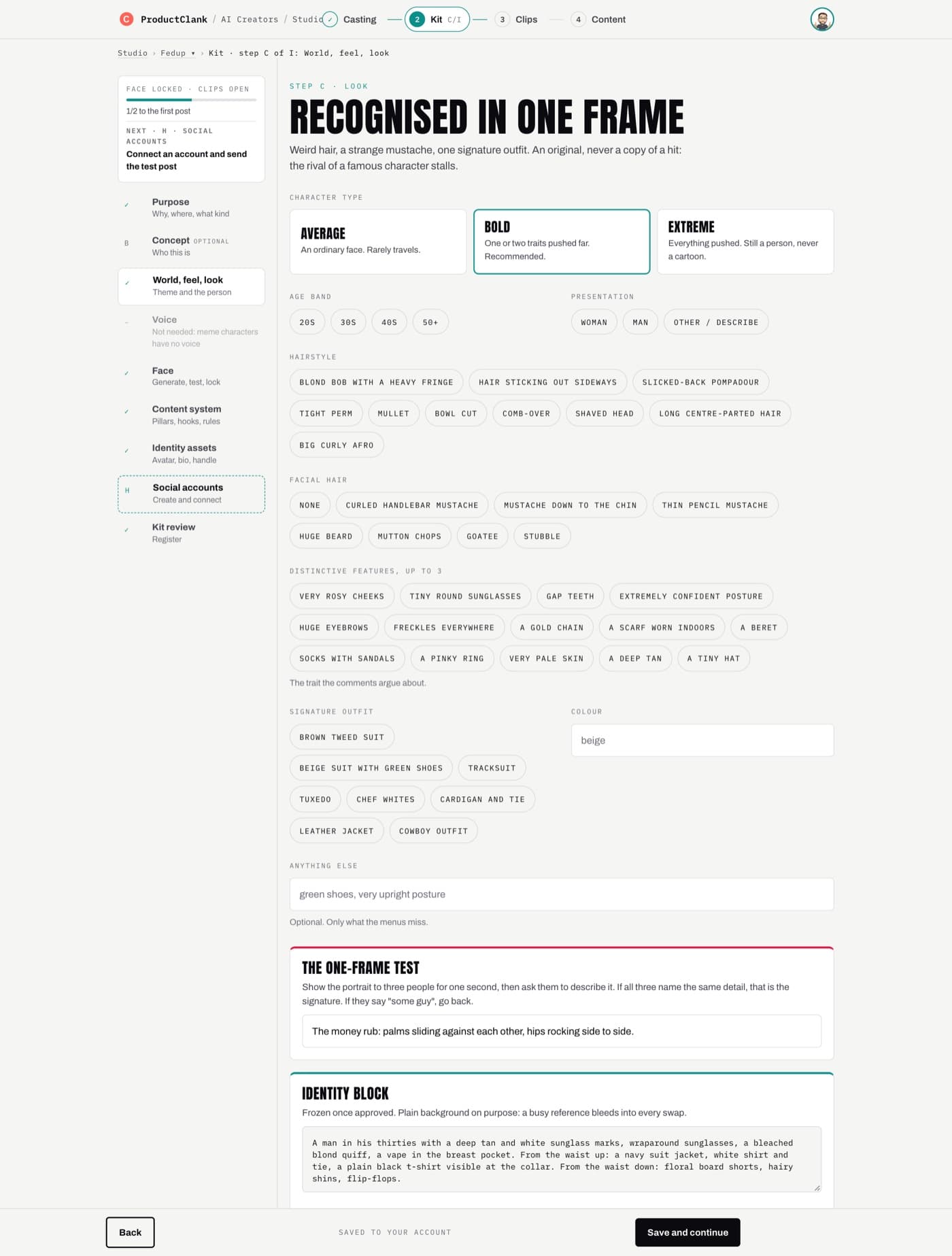
- The identity block. Under 80 words, pasted byte for byte into every later prompt. Ours: "A man in his thirties with a deep tan and white sunglass marks, wraparound sunglasses, a bleached blond quiff, a vape in the breast pocket. Navy suit jacket, white shirt and tie on top; floral board shorts, hairy shins and flip-flops below."
- The one-frame test. Show the portrait to three people for one second. If all three name the same detail, that is the signature. If they say "some guy", go back to casting.
- The front reference. Crop the front full-body view out of the sheet. The swap model takes one photo per person.
- Write and freeze the identity block yourself
- Check all eight panels for drift
- Crop the front view in an editor
- Pick type, hair, traits and outfit from menus
- The identity block is written from them and frozen on approval
- The front reference is cropped for you
- Identity edits after the lock are refused
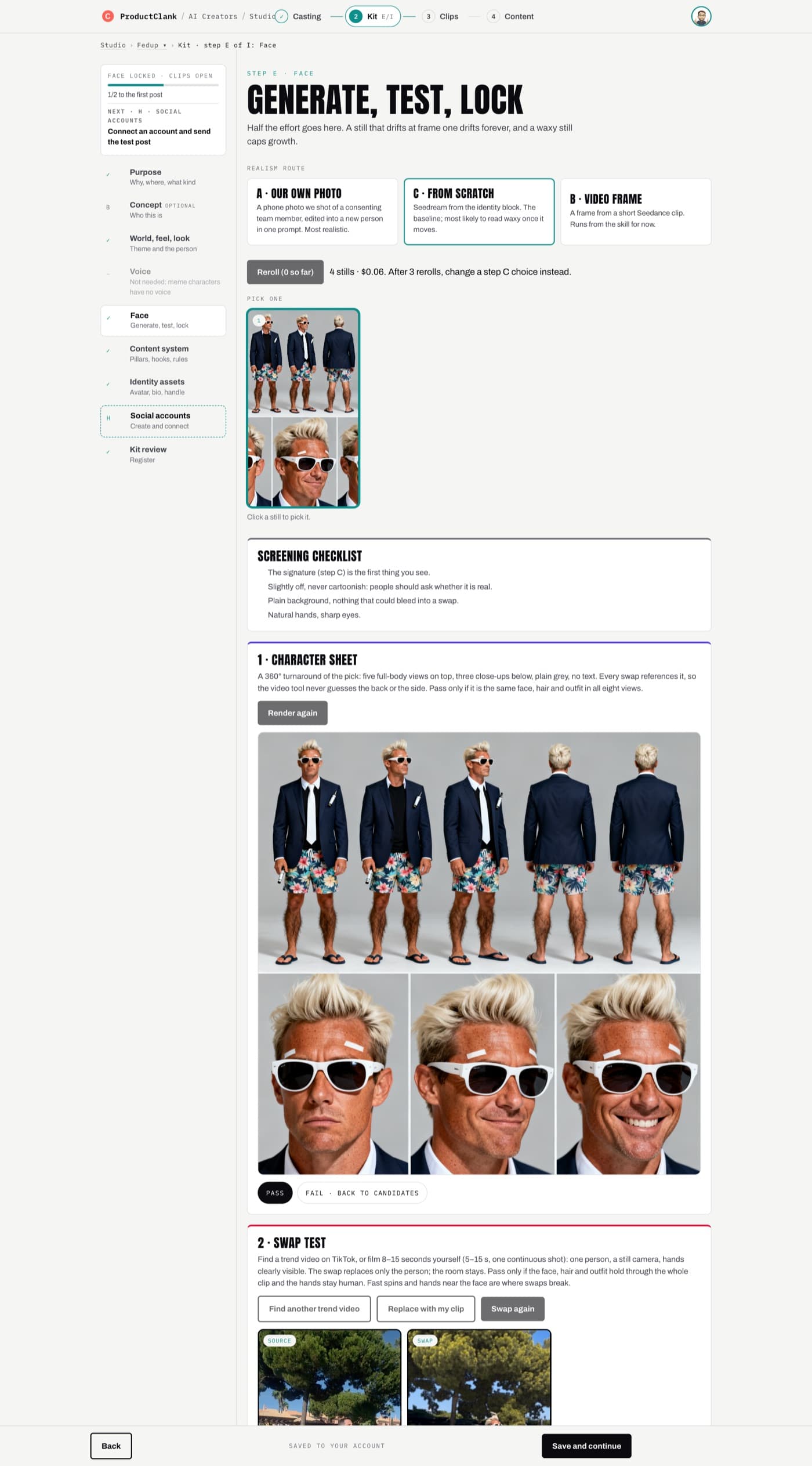
Test the swap
A face that holds in a still can fall apart in motion. Test it on real footage before you plan a single post.
Get a 5 to 15 second clip. Film it yourself: phone fixed at chest height, two to three metres away, head and upper body in frame the whole time, plain clothes, no close-ups of your hands, one continuous shot. Or use a trending TikTok clip of one person and credit its creator in your caption. Your own footage carries no copyright risk; someone else's does.
Upload it somewhere public and send it to MiniMax H3 recast with the front crop:
POST https://queue.fal.run/minimax/h3-max/recast
Authorization: Key $FAL_KEY

{
  "video_url": "https://…/clip.mp4",
  "reference_image_urls": ["https://…/front-crop.jpg"],
  "resolution": "768P"
}
Poll the status URL until the job completes (about five minutes), then copy video.url into your own storage. Recast replaces only the person; the room stays. Refused renders cost nothing, and the reason tells you what to fix: "no complete upper body" means step back, "too long" means trim. We tried three other models on the same clip: Higgsfield Genjutsu refused it twice, Wan 2.2 came out soft after 26 minutes, and Kling v3 builds a new scene instead (step 6).
- Upload, submit, poll, download, re-upload
- Decode refusals yourself
- Watch every take frame by frame
- Find a trend video on TikTok or upload your clip
- Clip length checked before upload
- Swap queued, stored and priced by its real length
- Refusals come back as what to film differently
- The face locks only when sheet and swap both pass
Plan the content
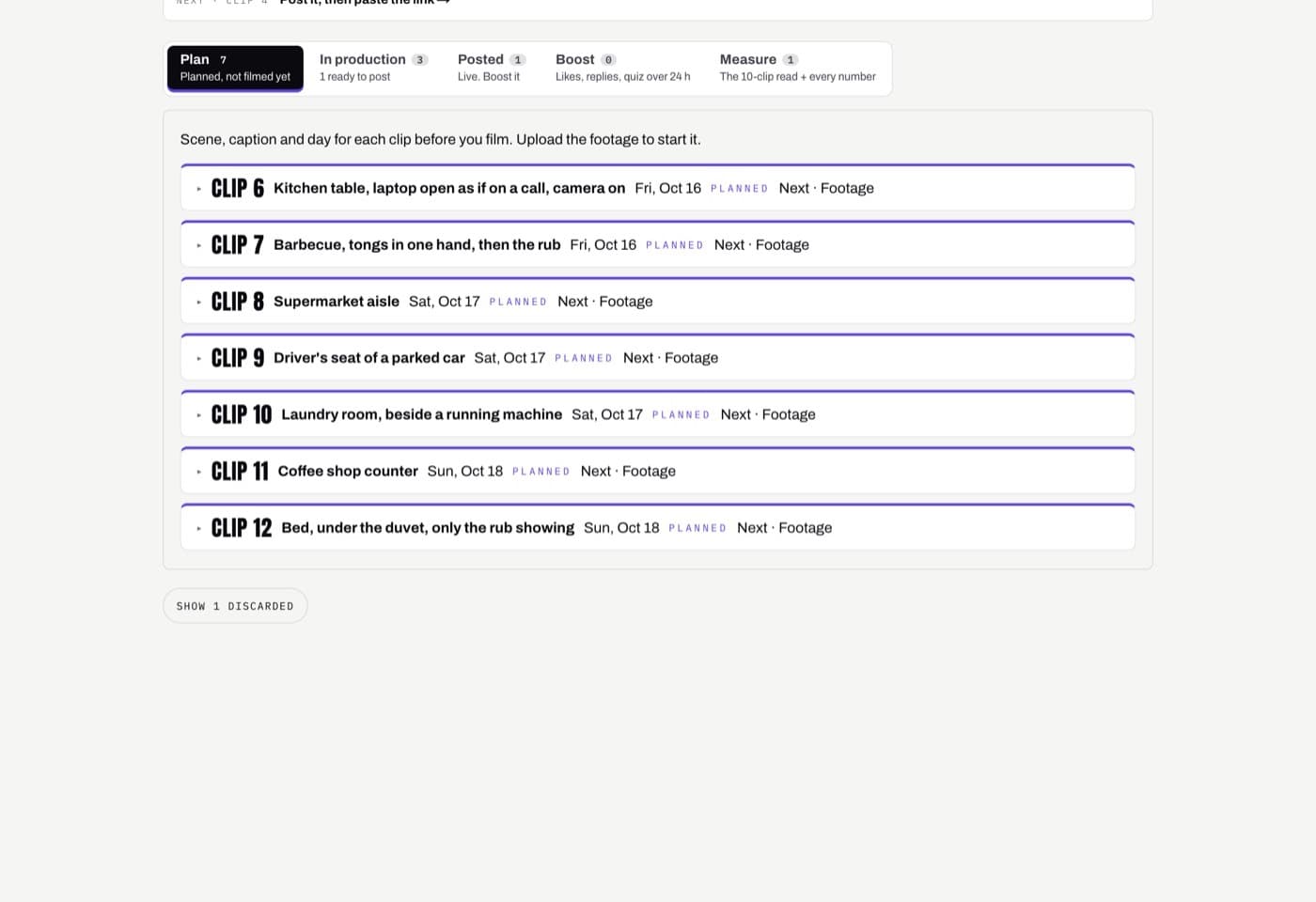
List at least three scenes you can film for free today. Ours: a kitchen table with a laptop open as if on a call, a barbecue, a supermarket aisle, the driver's seat of a parked car. Every clip ends on the signature gesture. Give each a date and a one-line caption.
Pick a cadence. The characters that broke out posted five or more a day at the start; we start at three. Write one disclosure line and use it everywhere. Ours: AI creator · made by ProductClank.
- A spreadsheet of scenes, dates and captions
- Keep files and plan in sync by hand
- Plan a clip: scene, caption, day
- AI drafts or improves the plan
- Clips move through Plan, In production and Posted on their own
- The one next action is always on top
Set up the accounts
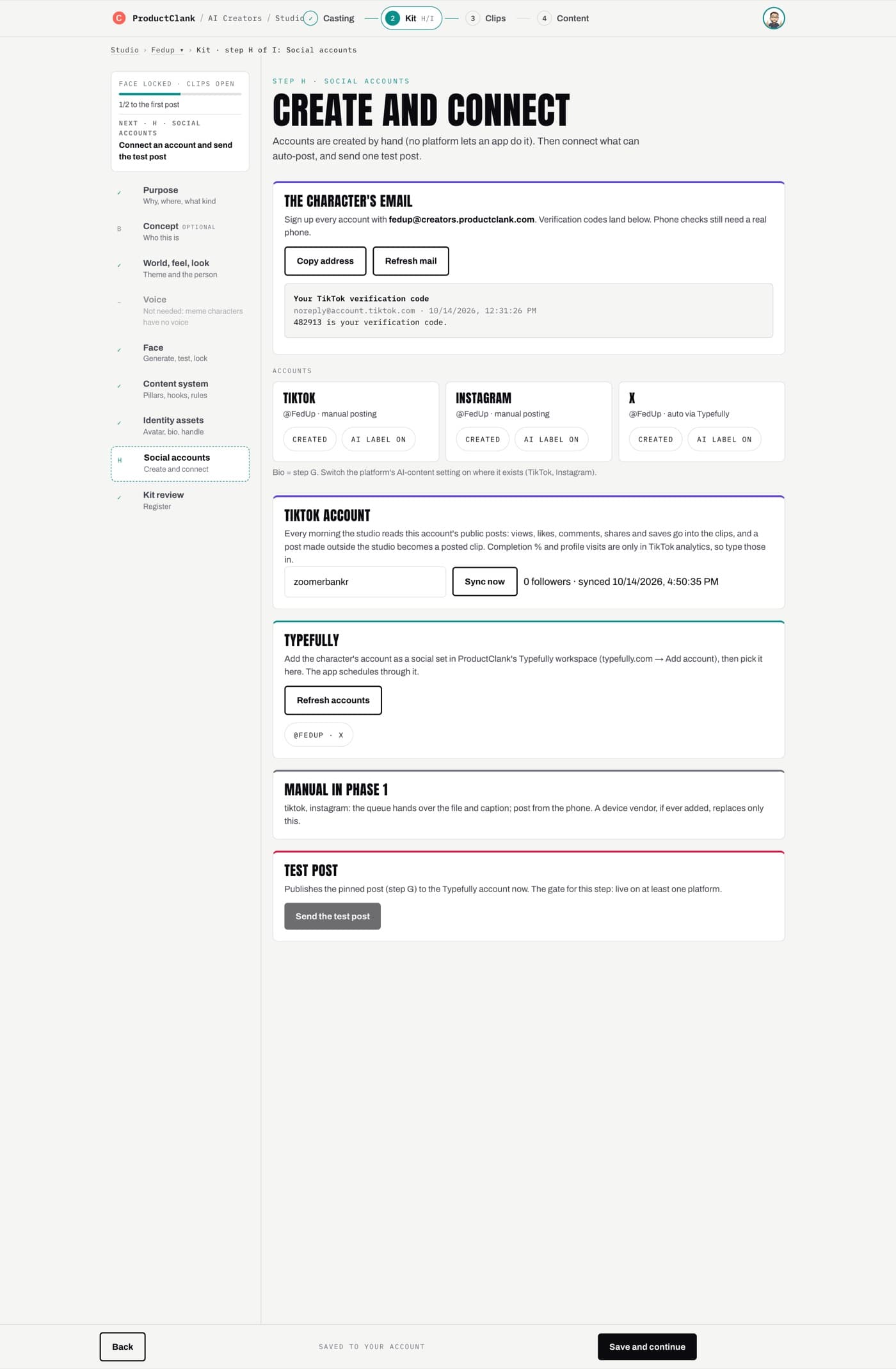
- Its own email first. Every sign-up and code goes there. A new Gmail works; a catch-all on your own domain scales better.
- Create each account by hand. No platform lets an app do it. Expect a phone check on most.
- Turn the AI label on. TikTok: More options, "AI-generated content". Instagram: Advanced settings, "AI info". X has no toggle, so the disclosure line is the label.
- Keep TikTok personal or creator. Business accounts only get the commercial music library, which rules out most trending sounds.
- Bio under 160 characters, with the disclosure line.
- A Gmail per character
- Copy codes between inboxes
- Check each handle on each platform
- A ready address per character, codes shown in the studio
- Bio drafted with the disclosure line
- Avatar cropped from any frame of the swap video
- TikTok account tracked for daily numbers
Make each clip
The daily loop. Keep the room: recast the clip as in step 3, take two to four takes, keep the best. Or put the character somewhere new:
- Grab frame 0 of the footage. The video model follows the still's framing, and a still from mid-clip put our character half out of frame.
- Make two scene stills with
fal-ai/bytedance/seedream/v4/edit: image 1 = frame 0 (camera and pose only), images 2 and 3 = photoreal references of the character (the person only), plus the setting. Use photos, not the sheet: a drawn sheet makes the model draw the whole scene. - Pick one and send it to Kling v3 motion control:
POST https://queue.fal.run/fal-ai/kling-video/v3/pro/motion-control

{
  "image_url": "https://…/scene-still.jpg",
  "video_url": "https://…/clip.mp4",
  "character_orientation": "video",
  "keep_original_sound": false,
  "prompt": "The man from the image performs exactly the movements
             from the reference video, in this setting: a beach,
             standing on a towel. Realistic phone video, natural skin,
             natural hands, no text."
}
Each take lands in three to six minutes. Cap yourself at four takes per clip; past that you are paying to avoid re-filming.
- Grab frames, prompt stills, submit, poll, download
- Match every take to its clip
- Re-film on refusals
- Keep the room or new scene, per clip
- Frame 0 grabbed in the browser; stills prompted for you
- Up to four takes, stored and priced
- You can leave the page while takes render
Post from the phone
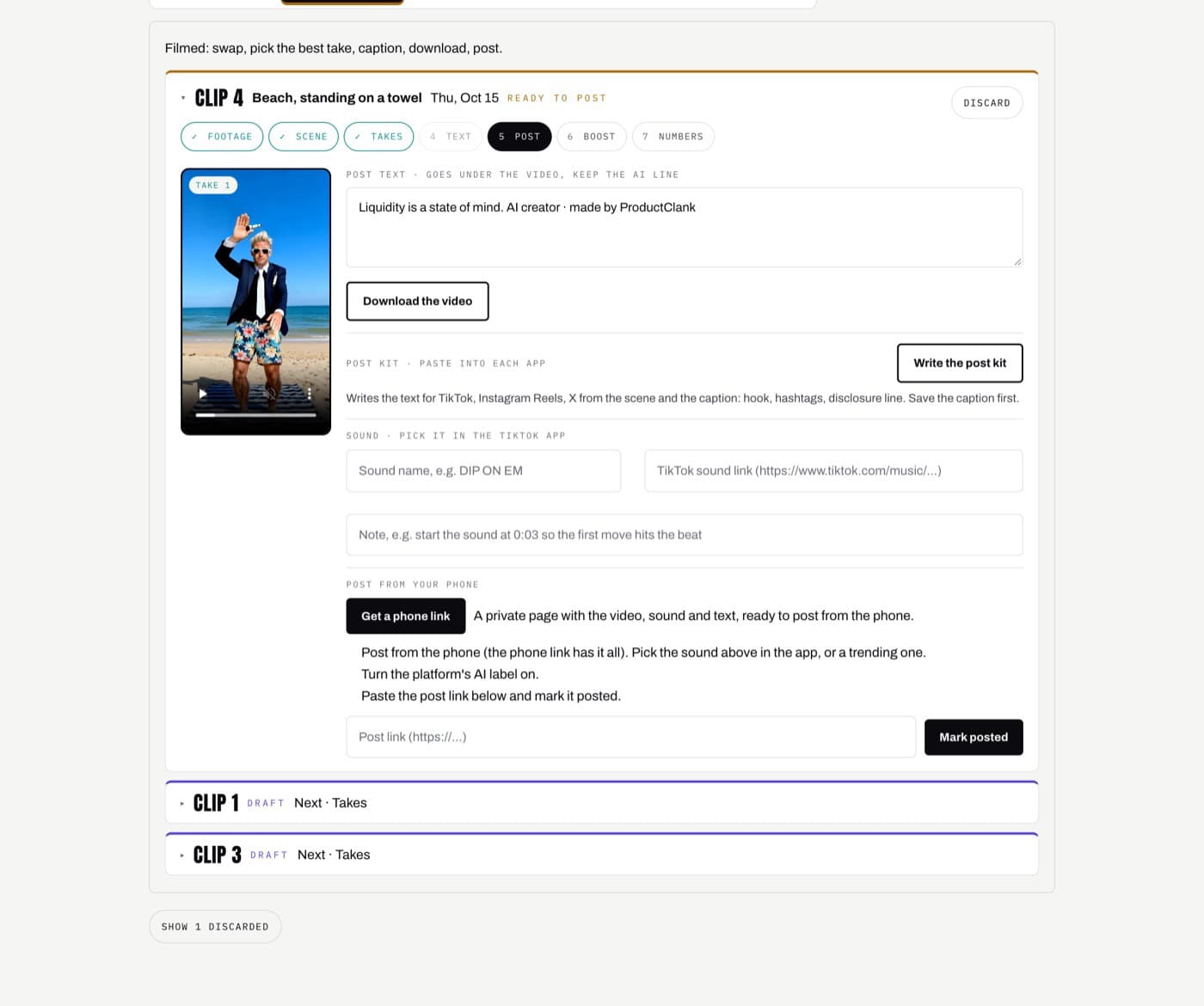
Write one text per platform. Keep the joke, make the first line earn the watch, end with the disclosure line, hashtags last: three to five on TikTok, five to eight on Reels, none on X. Keep money jokes as satire; never imply returns.
Post from the phone and pick the trending sound inside the app. Never burn a commercial song into the file: the video gets muted and does not count toward the sound's trend. Turn the AI label on.
- Write each platform's text
- Move the video, text and sound name to the phone
- Copy the post link back into the sheet
- The post kit writes every platform's text, disclosure kept in
- A private phone link: save the video, open the sound, copy the text
- Paste the post link and mark it posted
Read the numbers
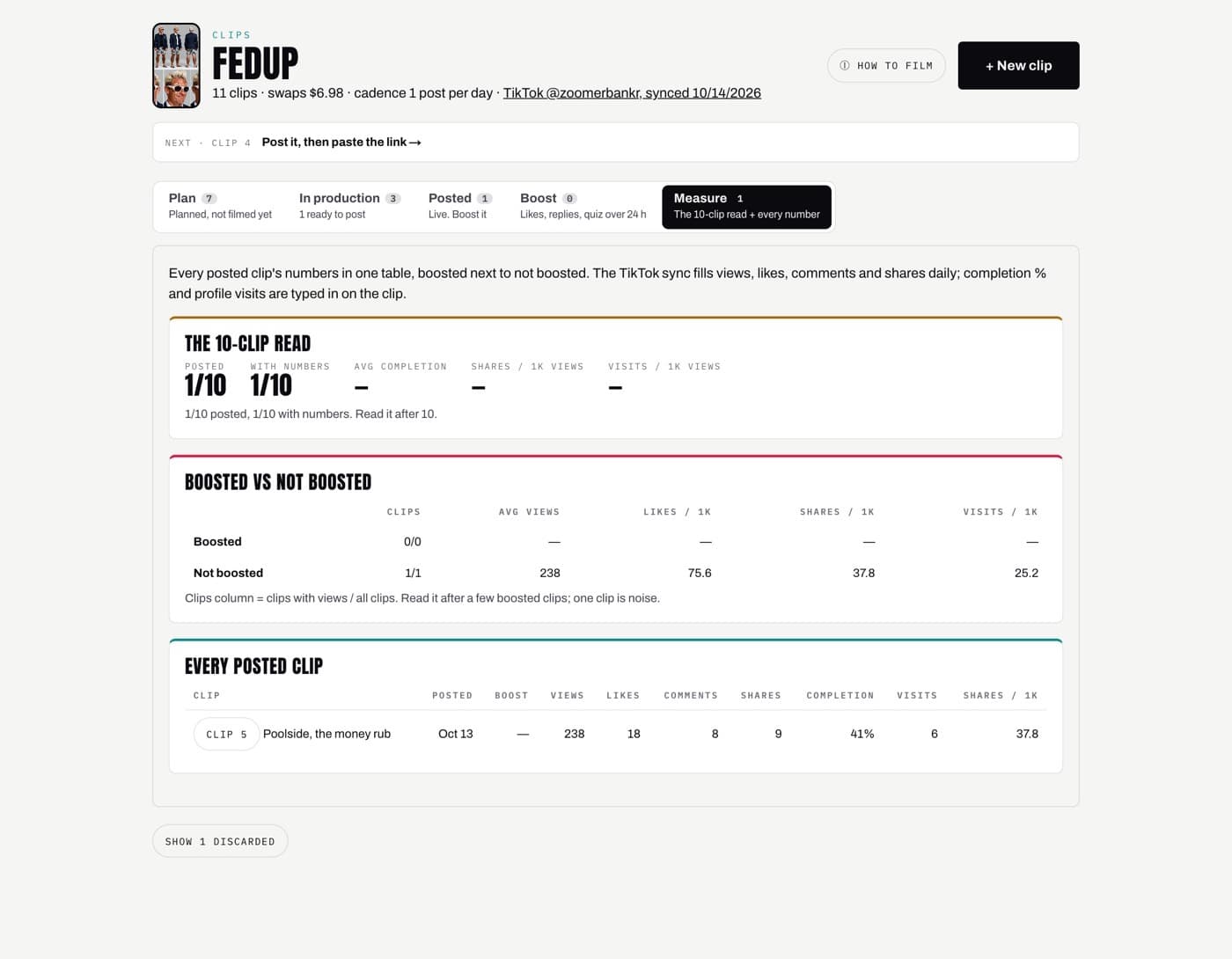
Log each clip 48 hours after it goes up: views, shares, completion rate, profile visits. Completion and profile visits only exist in the creator's own TikTok analytics, so you type those in.
After ten posted clips, do the read: shares per 1,000 views and profile visits per 1,000 views. If both are dead (we start with under 2 shares and under 5 visits per 1,000 views), change the character. Re-editing the same character rarely fixes it.
- Open every post's analytics two days later
- Copy numbers into a sheet
- Do the 10-clip maths yourself
- A daily sync pulls views, likes, comments, shares and saves
- Numbers flagged as due at 48 hours
- The 10-clip read and every posted clip in one table
A token
A character can have a token whose trading fees pay for its content. The simplest path on Base is Bankr: post @bankrbot deploy from the character's X account, or run bankr launch --chain base once. Bankr covers the deploy gas within its daily limits, and the fees go to one wallet you set at launch.
Be realistic. The creator's share is well under 1% of trading volume, so covering a few hundred dollars of renders a month takes tens of thousands in monthly volume. Treat it as a subsidy and a community, not the budget. And wait for an audience: a token launched on day zero gets one spike and then nothing. The studio does not launch tokens; this step is yours.
What it costs
Setup is about $5 to $10: one casting round is $0.63, a sheet re-render $0.06, a swap test $3 to $4.50. The monthly bill is almost all the swap model, billed per rendered second.
| Per month, one character | 1 clip a day, 1 take | 3 a day, 2 takes |
|---|---|---|
| Recast swap ($0.30 per second, keeps the room) | $65–90 | ~$540 |
| Or Kling new scene ($0.168 per second + stills) | ~$50 | ~$305 |
| LLM for post text and bios | <$1 | $1–3 |
| Scheduling, email, account sync | $0 | $0–13 |
| Storage and hosting, if you build your own app | $0 | $0–45 |
| Total | ~$65–120 | ~$310–620 |
Main case: 10-second clips, 2 takes, 90 clips a month. Rates are FAL list prices (October 2026). Our first rendered clips averaged $2.13 each on a single take. Hosting and scheduling lines are estimates. Not in the table: your time.
Run it in the studio
Casting, Kit, Clips and Content in one place: every loop above, with the files, prompts and numbers kept for you. The studio is invite-only while we run our own characters through it.